

Annual Meeting
days
hours minutes seconds
until
1st Annual Interdisciplinary Conference
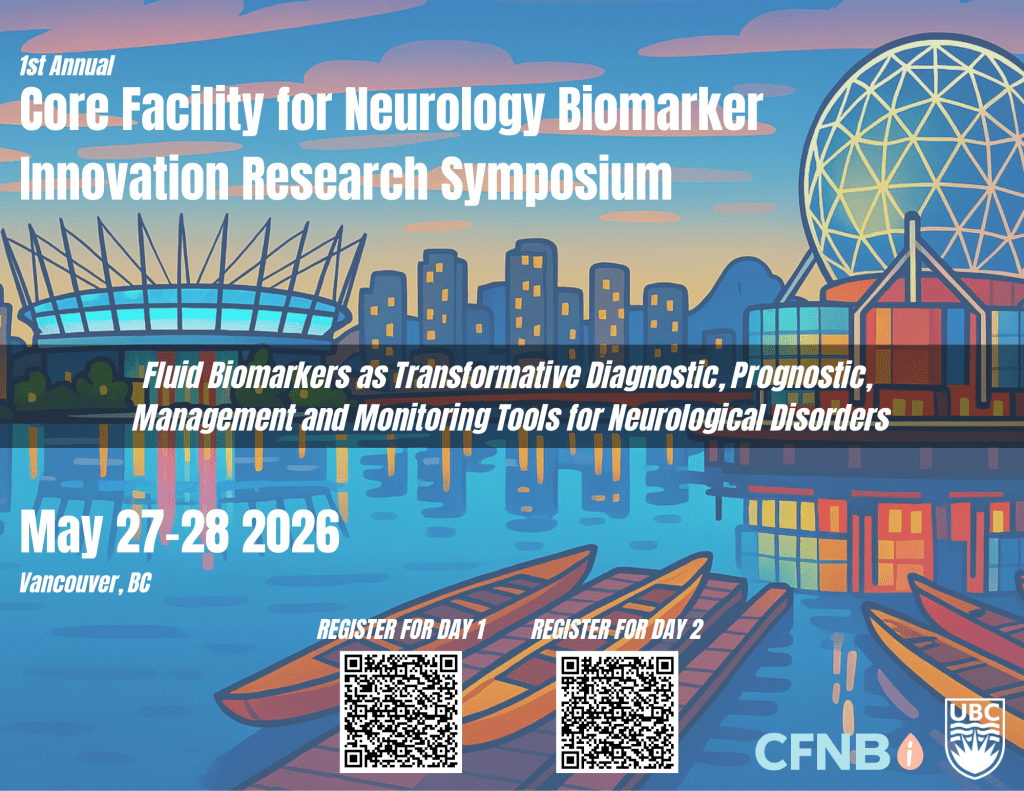
We are delighted to share that the Core Facility for Neurology Biomarker Innovation (CFNBI) will be hosting its 1st Annual Interdisciplinary Conference, “Fluid Biomarkers as Transformative Diagnosis, Prognosis, Management, and Monitoring Tools for Neurological Disorders,” at the Djavad Mowafaghian Centre for Brain Health and Vancouver General Hospital in Vancouver, BC, from May 27–28, 2026.
Due to the different locations and focus of each day, we’ve separated registration into two links. Please read about each event and register for the day, or both days, that interest you most!
May 27 – CFNBI Public Open House
We’re excited to welcome the community for an engaging evening exploring the role of biomarkers in advancing brain health research.
4:00–6:00 PM – Two interactive panels discussing the use of fluid biomarkers as diagnostic, prognostic, management tools for Alzheimer’s Disease and critical care.
6:00–9:00 PM – Reception featuring hors d’oeuvres and live music to foster connection and inspiration.
By opening our doors, we aim to spark curiosity about brain health and showcase CFNBI’s role in driving innovation in neurological biomarker research.
Location: Rudy North Auditorium, Djavad Mowafaghian Centre for Brain Health.
Please note: Sessions and reception require separate tickets. Register for both if you plan to attend both portions.
Confirmed Panelists
(More to be added)
Dr. Mypinder Sekhon is an intensive care physician and clinician‑scientist at Vancouver General Hospital. His clinical and research interests include multimodal neuromonitoring, cerebrovascular pathophysiology following brain injury, and ischemia–reperfusion mechanisms in hypoxic‑ischemic brain injury.
Dr. Dorothée Goulet is a neurointensivist trained in Montreal and Cambridge (UK), currently based in Vancouver for research. Her interests focus on advancing our understanding of neurophysiology through the use of advanced neuromonitoring across a range of clinical contexts.
Dr. Haakon Nygard leads a project to sequence the genomes of centenarians in search for a genetic cause of dementia-free aging. Dr. Nygard is the director of the UBC Hospital Clinic for Alzheimer and Related Disorders. As both a clinician and a scientist, Dr. Nygaard hopes to bridge the gap between basic science and clinical neurology to facilitate novel therapeutic development in Alzheimer’s disease.
Dr. Eric Smith is a Professor of Neurology, Radiology, and Community Health Sciences at the University of Calgary, and is the Medical Director of the Cognitive Neurosciences Clinic and a member of the Calgary Stroke Program. Dr. Smith’s research team investigates how cerebral small vessel diseases cause cognitive impairment and dementia.
May 28 – Scientific Symposium
Join us for our scientific symposium, bringing together researchers, clinicians, trainees, and partners at Vancouver General Hospital for a full day of knowledge exchange.
Sessions will cover biomarker research across multiple forms of dementia, clinical implementation, neurotrauma, and emerging innovations in the field, while also highlighting CFNBI’s history and leadership.
Patient stories and advocacy perspectives will be woven throughout the program to ensure the science remains grounded in lived experience. Lunch and snacks provided.
Location: Diamond Centre Auditorium (DHCC 1020 LT), Vancouver General Hospital.
A virtual option is available for those who cannot attend in person!
Confirmed Speakers
(More to be added)
Keynote Speaker: We are delighted to announce that the keynote speaker for the 2026 CFNBI Research Symposium will be Dr. Nicholas Ashton. Dr. Ashton is a world leader in the development, validation, and application of fluid biomarkers, particularly cerebrospinal fluid and blood‑based tests, in the fight against Alzheimer’s disease and related neurodegenerative disorders. He currently serves as the Senior Director of the Banner Research Fluid Biomarker Program, where he is at the forefront of advancing biomarker science. Dr. Ashton collaborates closely with academic and industry partners both within Arizona and internationally, driving innovation that is shaping the future of neurological research and clinical care.
Dr. Ramon Diaz‑Arrastia is a Professor of Neurology at the University of Pennsylvania Perelman School of Medicine, where he serves as Director of Clinical Traumatic Brain Injury (TBI) Research. For more than two decades, his research has focused on understanding the molecular, cellular, and tissue‑level mechanisms of secondary neuronal injury and neuroregeneration, with the overarching goal of developing effective therapeutic interventions.
Dr. Ava Puccio is a tenured Associate Professor in the Department of Neurological Surgery and Co‑Director of the Neurotrauma Clinical Trials Center. Her research focuses on improving outcomes for patients with traumatic brain and spinal cord injuries, with particular emphasis on controlled normothermia, mechanisms of brain oxygenation, and the exploration of biomarkers and genetic expression.
Dr. Frédéric Calon is a biochemist‑pharmacist affiliated with the Faculty of Pharmacy at Université Laval. His research program focuses on the development of novel therapeutic approaches for neurodegenerative diseases.
Dr. Roger Zemek is a pediatric emergency physician researcher with experience in multicentre studies, randomized controlled trials, and systematic reviews. His primary research interest is in pediatric concussion, including systematic reviews, guideline development, health administrative datasets, derivation and validation of clinical prediction rules, and interventional trials.
Dr. Michael Hayden is a Killam Professor of Medical Genetics at the University of British Columbia. His research focus is primarily on genetic diseases, including gene therapy, Huntington disease, predictive and personalized medicine and drug development. Along with his research team, Dr. Hayden has identified 10 disease-causing genes, which includes the identification of the major gene underlying high-density lipoprotein (HDL) in humans. This gene, known as ABCA1, has major implications for atherosclerosis and diabetes.
Thank you to our conference sponsors!
Platinum Sponsors


Gold Sponsors


 Core Facility for Neurology Biomarker Innovation